In 1976, while writing the Bicentennial feature series for The Freeman, a monthly publication by the Foundation for Economic Education (FEE), I wanted a secular basis for the Declaration of Independence’s rights to “life, liberty, and the pursuit of happiness”. A basis that could compel even an atheist to recognize that humans have these natural rights and that the government’s job is to protect them. I saw back then that we had a lot of confusion about the proper role of government. The common citizen didn’t know his rights or why he had them. If we don’t know those things, we cannot recognize when they are stolen.
I found the secular basis I needed when I realized that existence, the fact of being, entails the authority that is rightly identified as rights, natural rights. To be honest with the world, it deserves to know how this discovery happened, so I will relate that story. Some of you will not believe it, some will just wonder “what in the world?,” and some will embrace it as God’s truth. No matter how you react to this history, the fact that existence itself grants natural rights or authority stands independent and invincible. You may want to read “Temporal Rights: An Executive Summary” to see why that is so.
It All Began Fifty Years Ago
Today is the twelfth of March, 2026. Exactly a half-century ago, my wife and I attended a series of lectures delivered by W. Cleon Skousen. Cleon was the author of many excellent books, among them “The Naked Communist” and “The Naked Capitalist.” He presented these lectures to create an outline and a study guide to the US Constitution. He would use those in upcoming seminars on the Constitution offered nationwide by The Freeman Institute, which he was founding. His institute eventually taught the principles and glories of our Constitution to thousands.
I had a desire to write about political philosophy, but had no audience and little hope of acquiring one. Yet Cleon’s lectures were inspiring! He was an excellent storyteller, and his method included both laying out principles and telling stories about the miracles of the Revolutionary War. One night, as I knelt beside my bed as usual, I thanked God for another inspiring lecture. My desires to write and help the cause of freedom were pressing upon me, and I talked about that and the challenges I saw. I concluded by saying, “If I could be of any help, I would be pleased.”
A New Message
I awoke at 1:30 am with the thought that I could write as though I were one of the founders – a venture perhaps into name-dropping. As I lay there, I began to imagine what I would say. My mind seemed to run away with the thought and soon I had to find a pad of paper and pencil and begin writing because a speech such as the founders might give, poured into my mind. For the next three hours, writing as fast as I could take notes, the speech continued while tears rolled down my cheeks and my heart felt so full I worried about it. That was just the beginning.
Over the next several weeks, I had to keep a legal pad and pencil near me because I didn’t know when the next speech would come – always with the same deep emotion, tears, and a fullness in my chest. I used these notes, added my own thoughts stimulated by them, and wrote three essays, which I then took to Cleon Skousen for his opinion. He encouraged me to use the Writers’ Digest and see if I could get them published.
The Freeman Snaps Them Up
I submitted them to The Freeman magazine, published by the Foundation for Economic Education (FEE), where Editor Paul Poirot snapped them up. He asked if I was going to write more, and I said I was pretty sure I could do that. So in the issues from May through December of 1976, The Freeman carried their Bicentennial feature series entitled “A New Message, Words of courage and counsel from the hearts of the Founding Fathers to their Children in a troubled nation.”
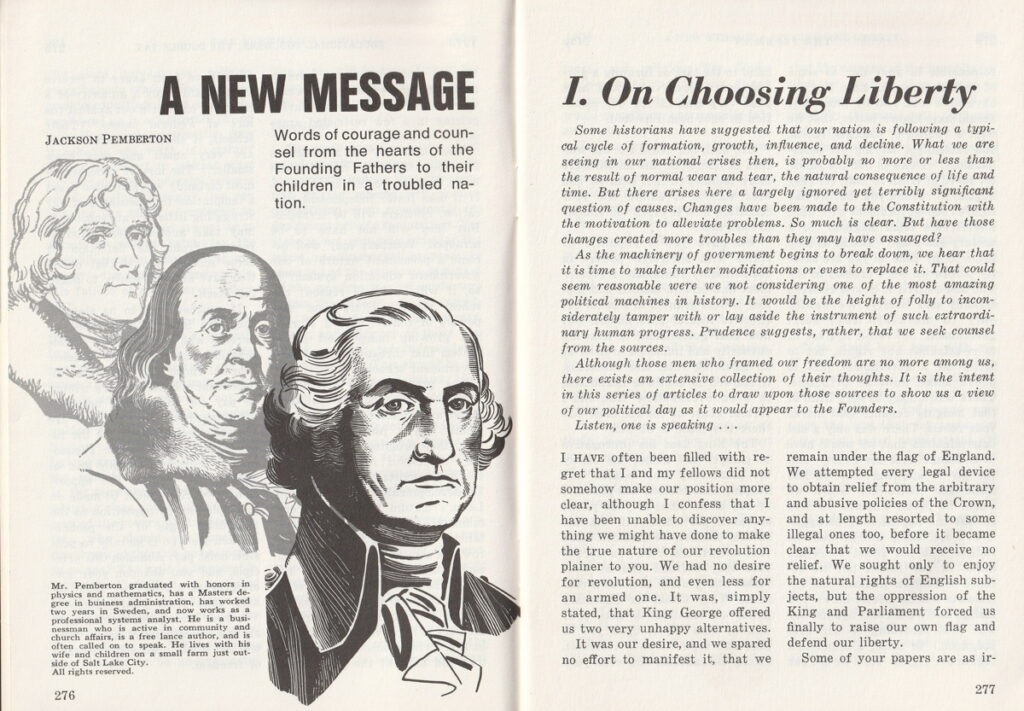
I received many letters that year, some in praise, one in contention, and several asking for permission to reprint. Ezra Taft Benson, who served as U.S. Secretary of Agriculture under President Dwight D. Eisenhower, was on FEE’s Board of Directors at the time. He called to congratulate me on a “fine series” and asked what I intended to do with it – a question that haunted me during the following decades.
Temporal Rights
The second essay in the series was “On Human Rights and Government” and when I wrote it I had to write about natural rights because they were clearly the foundation of the new government. The statement in our Declaration of Independence, “endowed by their Creator”, troubled me because so many of my fellow countrymen didn’t believe or outright denied him. I wanted a basis for rights that could survive atheism. You can understand my hesitation in asking God for such an idea – a basis that left him out of the picture. But I managed the audacity and asked.
Immediately, there came into my mind the idea of the rock, tree, and beaver that I often refer to in my work on Temporal Rights. Given the fact that trees could split rocks, and beavers could cut down trees, I began to see that a single rhetorical question could elicit this new understanding of natural rights: “Does a beaver have the right to cut down trees?”
As I wrote that second essay, I was able to develop nearly all the fundamental ideas of Temporal Rights, a name I only recently gave them. (I tried a number of other names but God would approve none of them.) A few years later, I had forgotten about that essay’s explanatory paragraphs, remembering only the rock, tree, and beaver. Then, in 2018, I began to want to write again, and I thought to write a book about church and state because I could see that the “wall-between-them” concept was founded on a false dichotomy. Those were busy years, and with little time to write, my focus drifted, finally fastening on natural rights. I felt certain that there was a powerful basis for them that non-believers would be compelled to acknowledge.

The Depth I Needed
Family and housing took precedence, and very little writing got done until 2024. By then natural rights were in the back of my mind constantly, and I managed a little writing, but I was anxious to get them clearly, logically, and philosophically anchored and articulated.
We live off-grid at over 8,000 feet elevation in the Rocky Mountains and are snowed out of our cabin during the wintertime. Last winter, while camped in our RV in the deserts of Arizona and Utah, I was able to focus. A pattern that I had experienced before strongly reemerged: pray for understanding, go to sleep, wake up at 4:30 am with the answer. This happened over and over last winter while I wrote most of “A New, Secular Proof of John Locke’s Natural Rights“.
That was the first time I had really gone deep and laid out the philosophical underpinnings. I had no training in philosophy or law, so it took real effort. Afraid that my thinking could be biased by studying historical theories of natural rights kept me from drawing on that resource. But I was and still am determined to fully understand and articulate natural rights for both the average citizen and hardcore political philosopher.
Why I Need So Much Inspiration
When I was fifteen, my parents had my aptitudes tested. The counselor advised me to avoid law as I thought about a vocation. He said I would be able to succeed at it only with a huge effort. Perhaps that is why I have required almost constant inspiration from the Almighty in order to write sensibly and coherently about natural rights.
On the other hand, it is my degree in Physics that has allowed me to clearly see the machinations of the universe. In fact, a few years ago, when I was starting to pick up the natural rights thread again, I read these two quotes from Einstein: “Look deep into nature, and then you will understand everything better,” and “The intellect has little to do on the road to discovery. There comes a leap in consciousness, call it intuition or what you will, and the solution comes to you and you don’t know why or how.”
Ruminations and Revelations
I reasoned that natural rights should be discoverable in nature first of all, and when I visualized the workings of the tree and the beaver and pondered over what I was watching, I realized that they were exercising authority: that they had dominion over their resources.
When I saw that even inanimate objects like rocks and planets were not just lifeless things, but agents exercising their rights, powers, and dominions, the universe seemed to come alive like a great organism whose cells were galaxies teeming with actors flexing their capabilities to the limits of their creation, effecting change, advancing the organization of the universe, fulfilling their individual destinies, and while so doing, fulfilling the destiny of the universe. It is a beautiful and sweet vision when things you thought were dead come to life.
Encouragement
As all writers know, there are times when text almost writes itself and others when there seems to be only emptiness. During one of those times, I prayed and asked if I was done, although I didn’t think so. That was the evening of March 25, 2025. I woke the next morning at 1:11 am with an insight into Temporal Rights that I added to a post I was working on. You probably won’t believe the rest of this, but it’s true.
The next night, I awoke at 2:22 am with another insight. And so it continued through 3:33, and then at 4:44 am Saturday morning, there was the idea that issues in court trials should be seen as conflicting rights. Then Sunday morning, the 30th, this came at 5:55 am: “Jurisprudence cannot be even-handed while crudely casting conflict in the simplistic framework of perpetrator/victim.” You must understand that these wakenings were abrupt. I would open my eyes, look at the microwave in our camper to see the time, and there it was. (I don’t remember the insights of the first three nights because I didn’t journal them.) I felt that God would still try to use me since I continued to volunteer.
Today, having turned the Temporal Rights framework every which way but loose, I feel confident enough in my ability to articulate it. A few days ago, I decided to review the first knowledge given to me in “On Human Rights and Government“. I marvelled that the major points I had labored to expound last winter were all there, including their existential nature. The following paragraph outlined the central discovery:
“Let us not cloak the matter of human rights in any mantle of mysticism: they do not arise from some philosophical argument, or inscrutable religious dogma; they are as real as the powers from which they spring! What precisely is a right? It is the authority or prerogative to use an inherent power or capacity. All creatures come into existence with certain powers and the necessary authority to employ them; or, to what use is a power if there be no right to exercise it?”
Covenants of the Father
God has a bunch of children and, like any father, he wants them to grow up and be like him. Maybe he’s tired of playing chess with his computer and wants real people with comparable intelligence so the game is fun, or something like that. I don’t know, but I am convinced that he wants all of his children to have use of their rights so they can advance as far as possible. I think he gave us the ability to think, plan, and choose, so we would learn how to do that skillfully.
But most of all I believe that he made a deal with us, a covenant between each one of us and him. If we would be good children and have confidence (faith) in him and in ourselves, he would see to it that we had a continuation of opportunities until we had progressed as far as our desire for progress could take us.
That covenant has provided us with the universe for our home and our rights for our glory or damnation, depending on our choices. I think he baked natural rights into the structure of the universe so they would always be with us as we learn to act and not to be acted upon, as we exercise our dominion and learn to do it with attention to the rights of everything in our domain. I believe that might be a definition of righteousness.
The Divine Covenant
But the most touching and the most powerful covenant is the one between the Father and his Son, Jesus Christ. The Son, whose humility and the infinite service he rendered us in his Atonement, has let us avoid the just consequences of our mistakes and deliberate and unnecessary violations of others’ rights. – sin. Such a gift is almost unimaginable. His love, and our love if we will exercise it, are the greatest forces in the universe because love never forces anything. He gave us the capability and the right to choose, and the highest choice is to love.
Let us therefore in humility, love God and one another.
Finally, I want to say that I know with a surety stronger than my knowledge that the sun will rise tomorrow, that there is a God in heaven and that he is not just mindful of his children but anxious and engaged in doing all possible things to help us learn to be good children while maintaining a distance sufficient to assure our freedom is never, ever compromised. And I know that that is all he asks – that we sincerely and wholeheartedly try. That we fail betimes was and is expected and the Atonement of Jesus Christ has already been invested and waits for our humble use of it.
Again, let us, in humility, love God and one another.
Jackson Pemberton
Maarch 12, 2026