We live in a time when the sheer number of non-believers has given them the advantage. They have taken over positions where they can trample the rights claimed in our Declaration of Independence. And now they threaten to deny believers their rights to believe and practice that belief. When the best we can do is insist that natural rights were endowed by a Creator whose existence they deny, we look weak, desperate, and foolish in their eyes, and they see no reason to respect the rights of fellow citizens.
Posing a rhetorical question and a little logic reveals a new, secular basis for natural rights that shows them as part of the fundamental fabric of nature: shows them inseparable from existence. This means that if these rights are denied, then a person is not fully a person anymore but some reduced form of humanity. This foundation is secular. It does not depend on religion, political expediency, social relations, moral obligations, traditions, customs, cultural norms, or any basis other than the realities of existence. This provides a way to keep non-believers on the path of John Locke’s natural rights – life, liberty, and property. Let me explain how that works.
Does a Beaver Have the Right to Cut Down Trees?
This question goes right to the heart of the matter. It is self-evident that the answer has to be “Yes”. If we try to dodge and answer “no, because he doesn’t have the right to cut down my trees”, we have acknowledged his right to cut down other trees. If we answer with a final “no,” we have said he has no right to exist. But he does exist, and he cuts down trees.
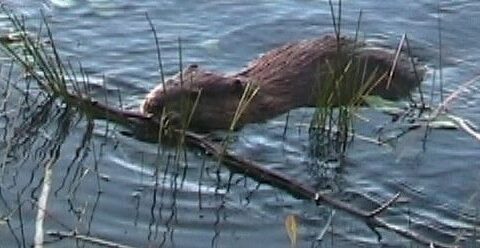
When my wife and I worked for Alaska State Parks during the summer of 2005, we were assigned to a cabin on Red Shirt Lake, where a part of our job was to see that the local beavers didn’t fell trees onto the thirty boats stored beside the cabin. We had no means to prevent them, but we could watch and finish felling their tree before they could, and ensure that it fell in the right direction. Beavers are fun to watch.
You probably didn’t notice how comfortable you were with the phrase “their tree”! That’s because when a beaver exercises his rights, he adds his time and effort to the tree and it becomes a part of his domain and is rightfully “his”. This is the principle advanced by John Locke, explained in Chapter V entitled “On Property”, in Article 27 of his “Second Treatise on Government”. We can recognize the truth of this proposition in a sort of intuitive way, but property ownership is found solidly in a more fundamental look at the nature of existence.
Property Rights
In our Declaration, Jefferson wrote “life, liberty, and the pursuit of happiness.” I think he would have preferred to say “property,” but that word was strongly associated with slave ownership, and he didn’t want to support that idea.
The property rights of rocks and trees are self-evident. They cannot exist without their property. A logical extension of those rights demonstrates the property rights of the beaver and people. The property rights of rocks and trees encumber a fixed bit of real estate, while those of the beaver and people must extend to whatever is part of their domain of activities essential to their continued existence. This connection of rights to existence is the key to the new, secular view of natural rights that I have named Temporal Rights.
Temporal Rights
They are temporal because their foundations are secular, and that is the primary definition of the word. But these natural rights come into existence in the instant of the creation of their owner and are extinguished in the instant of his demise, and are thus time-based only in that respect.
The Domains of the Tree and the Beaver
In fact, all the activities of the beaver taken together define his domain. Or, in other words, he has dominion over his own activities and the things outside his own body that are needed for his existence. Now, here’s the thing that proves the natural rights of the beaver.
A beaver in Red Shirt Lake chews bark off a limb for his breakfast.
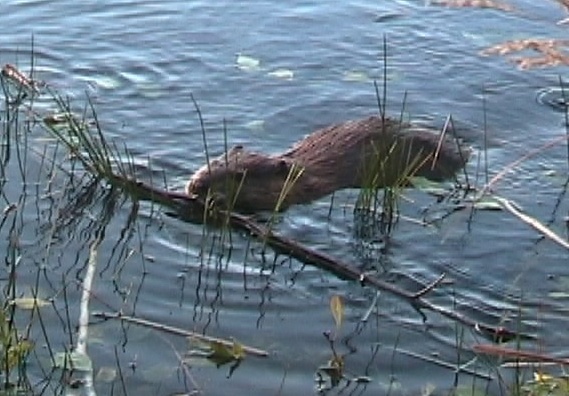
Does a beaver have a right to breathe? Of course. Is that right stronger than his right to cut down trees? Maybe, but the tree operation is as essential to his existence as breathing, just not as immediate. So the beaver has rights within his domain to do what beavers need to do to exist as beavers. These rights are necessary and sufficient to his existence. This is how the very nature of the beaver exhibits his rights to life, liberty, and property. To put this in philosophical terms, these rights are an existential aspect of the beaver’s right to life.
These rights are inherent and intrinsic to the nature of the beaver. They are also inalienable because if you try to separate them from him, he cannot operate properly. The natural rights of the beaver are baked into his existence. These natural rights exist because the beaver exists as a beaver. So let’s take a closer look at the idea of natural rights.
What is a Natural Right?
A natural right is an authority of a creature to do what is required by its existence. The beaver has natural authority to operate in his domain. If we see the power and authority of the sun to hold its planets in orbit, we can expand this principle to include inanimate objects we call operators. It is the nature of the sun to do what it does, and we can see that those activities are necessary and sufficient to its nature. It is clear that the sun has the power and authority to hold its planets in their orbits. You can’t stop the sun from doing that unless you stop gravity which you can’t do without converting the sun into nothing. So a natural right is the authority to operate just like a driver’s license is the authority to operate. But let’s go back to the trees.
Universal Rights
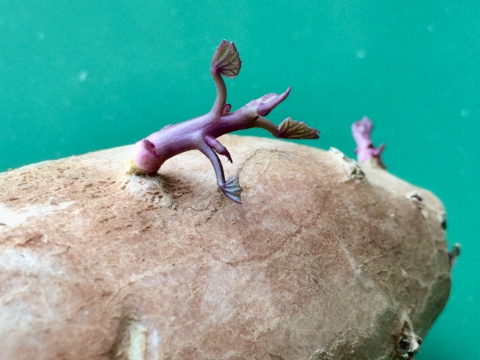
We can ask a similar question about trees that we asked about the beaver. Do they have the natural right to organize sunlight, portions of the soil, and water? The answer is “yes,” because that operation is necessary to the existence of trees. If they are denied those rights, they cannot be.
This establishes a pattern that can be applied to every self-existent thing in the universe. By self-existent, I mean anything that is composed of matter of any type. So abstract things have no natural rights. Society and forests, for example, have no natural rights, but individual trees do. Abstractions are not palpable things and have no self-existence because they have no native capability.
An interesting summary of all this can be found in what seems like a play on words: Natural rights are a natural part of the nature of nature. This is nevertheless a correct statement that demonstrates the intrinsic or inherent aspect of natural rights.
Even Rocks Have RIghts
This seems like a stretch of imagination but it is an interesting thought because it so clearly demonstrates the nature of natural rights.
A rock has the authority to operate in its space (which is simply taking up space). That operation is passive, of course, but it defends its right with determination. A rock has a right to the space it occupies. It takes a bit of work to violate that property right and split or crush a rock, but in the process, we have violated not only the right but the rock itself. It is physically impossible to separate a rock from its right. The point is that, like a rock, we the people can not be deprived of our rights to life, liberty, and property without destroying at least a part of our lives. It makes us less human and more like a rock that can’t do anything but take up space.
Secular, Natural Rights in Summary and in the Words of Temporal Rights
A natural right is the authority of an operator (tree, beaver, human) to operate its own capabilities. These operations define its domain – the space within which it has sufficient dominion to operate its capabilities. These rights are inalienable because they cannot be separated from tne capabilities that gave rise to them without destroying the corresponding capabilities. They are inherent because the capability and the right are just two ways of looking at the same phenomenon.
A more technical, philosophical, and ontologically articulated description of Temporal Rights can be found here.
Our Natural Human Rights
We humans, would do well to remember this simple fact: our natural rights cannot be separated from our lives without damage. Violation of our natural rights is a violation of our existence. That explains why we feel so violated when our rights are infringed; the feeling is both appropriate and accurate.
What can we do about? Study these rights here and then talk about them, explain their origin and demand they not be infringed.